

Is Your Home Office Holding Your Business Back?
Running a business from home is one of the smartest ways to test a business idea: low overhead, no commute, and the freedom to set your own hours. According to the Australian Bureau of Statistics, around 37% of Australians worked from home at least once a week in 2023, and many of those are operating a home business alongside or instead of employment. Whether you sell physical products, provide services, or consult online, the appeal holds true regardless of your type of business: you keep your personal finances and professional ambitions under one roof.
You also get to claim tax deductions on running expenses and, in some cases, occupancy expenses like mortgage interest, council rates, land taxes, and house insurance premiums, which directly reduces the income you pay tax on. But here’s the thing most business owners don’t say out loud: the same setup that launched your business can quietly start to limit it.
There’s a point in every home-based business journey when the spare room starts to feel less like a launchpad and more like a bottleneck. You might not be able to name exactly what’s changed, but something has. Below are 10 signs your business has outgrown what your home setup can sustainably support, and what to do when you spot them.
Here are the 10 signs that your home business has quietly outgrown its surroundings, and what each one is really telling you about where your business needs to go next:
- Your productivity is suffering from constant home distractions
- You’re losing clients over your home address
- You’ve run out of room for stock, displays, or fulfilment
- Client and team meetings are getting awkward
- The tax maths on your home office no longer stacks up
- You can’t attract or retain the staff you need
- The line between work and home life has completely disappeared
- You’re turning away business because you don’t have capacity
- Your brand image doesn’t match the business you’ve built
- You spend more time managing home logistics than growing your business
Why the Home-Based Business Model Works, Until It Doesn’t
The Smart Start That Can Become a Strategic Bottleneck
A home-based business makes enormous sense at the start. You skip commercial rent, keep your business structure simple, and build your financial plan without a large fixed cost eating into early revenue. Home businesses span everything from eCommerce and freelancing to consulting, coaching, and content creation, all legitimate, scalable business types that begin well in a domestic setting.
From a tax standpoint, the ATO allows home business owners operating as sole traders or partnerships to claim deductions on both running expenses (electricity, phone, equipment depreciation, furniture and furnishing repairs, and cleaning) and, where a dedicated space is set aside exclusively as the principal place of business, occupancy expenses such as mortgage interest, council rates, and home and contents insurance.
You may also be able to claim running expenses for the business use portion of your home even without a fully dedicated room. A good example: a sole trader who sets aside a spare bedroom permanently for work is able to claim occupancy expenses; one who works from the kitchen table typically is not. Using accounting software from the outset makes tracking these expenses and separating personal from business costs significantly easier.
But the features that make home appealing in the early stages (informality, proximity to personal life, low cost) become structural liabilities the moment growth arrives. More clients mean more client visits. More orders mean more storage. A larger team means home and other locations blur into a single chaotic workday with no set hours and no boundaries. The home business that made sense at $100K turnover starts to actively resist the business reaching $500K.
Is Your Business Address Quietly Costing You Clients?
A Virtual Office gives your business a premium Alexandria address with professional mail handling and part-time access to physical workspaces and meeting rooms, from just $65/month, with no long-term commitment required. Get a feel for the community and workspace in this behind-the-scenes look at Workit Spaces on YouTube before you commit to anything. Call us today – (02) 9381 9100
How to Know It’s Time to Make the Move
Reading the Growth Signals Before They Become Growth Blockers
Most business owners don’t wake up one morning knowing they’ve outgrown home. The signs come gradually: a meeting that felt awkward, an inquiry that didn’t convert, a week where you worked until midnight because the environment made it impossible to switch off. The checklist below is an honest self-assessment, not a crisis list.
It’s also worth knowing that moving doesn’t have to mean signing a five-year commercial lease. Flexible office spaces in Alexandria, Sydney now offer month-to-month terms, scalable layouts, and professional business premises without the commitment- a genuine middle ground between home and a traditional tenancy. With that context in mind, read through the 10 signs and count how many apply to your own business right now.
10 Signs You’ve Outgrown Running a Business From Home
Sign 1: Your Productivity Is Suffering From Constant Distractions
Home distractions are insidious because they feel minor in isolation. A delivery at the door, a family member needing something, the background noise of the television two rooms away- none of it seems significant until you add it up. Research consistently backs this up: a Productivity Commission report found that 31% of remote workers regularly feel more stressed and burnt out, and 42% experience loneliness and isolation. These aren’t soft complaints; they’re signals that the environment itself is working against you.
A dedicated space, even a dedicated desk in a coworking environment, creates the physical and psychological cues that signal “work mode.” You arrive, you focus, you leave. The transition is the thing. When your place of business is also your kitchen, your living room, and your bedroom, that transition never happens. And without it, your productive hours quietly shrink.
Sign 2: You’re Losing Clients Over Your Home Address
In many B2B relationships and procurement processes, address legitimacy still matters. A home address on an invoice or email signature introduces doubt in a way that’s hard to quantify but very real. Businesses can use a post office box or virtual office service as their postal address for both convenience and privacy, particularly relevant when you don’t want to give out your home address to clients or customers.
A virtual office solves this cleanly: you get a premium business address with mail handling, a professional home address for your Australian Business Number registration, and part-time access to physical workspace and meeting rooms, without the cost of a full-time tenancy. It’s one of the most cost-effective tools for lifting perceived professional credibility.
Sign 3: You’ve Run Out of Room for Stock, Displays, or Fulfilment

For eCommerce businesses in particular, this sign hits fast. The garage becomes a makeshift warehouse. The hallway fills with boxes. Courier services are scheduled around who’s home to answer the door. It’s not just inconvenient; it’s a compliance and safety risk.
Business.gov.au is clear that depending on your business activities, you should contact your local council and ask about approval requirements, including in cases where your business produces significant wastewater, creates extra vehicle traffic, or involves activities with health and safety implications, such as food preparation, beauty treatments, or childcare. Standard home and contents insurance policies typically do not cover business activities either, and you may need to add public liability insurance if clients visit your home.
These aren’t minor admin tasks; for a growing business, they represent real liability exposure. Residential zoning wasn’t designed for commercial warehousing, and growing eCommerce brands regularly hit its limits.
Sign 4: Client and Team Meetings Are Getting Awkward
The café meeting workaround works once or twice. But clients notice when there’s no permanent business premises. Zoom calls interrupted by household noise undercut the professional image you’ve worked to build. And for team gatherings, the absence of a whiteboard, AV equipment, or a private space makes planning sessions clumsy.
Access to a professional meeting room, even on an ad hoc basis, changes that dynamic immediately. For larger sessions, presentations, or brand events, an auditorium or event space accommodating up to 80 guests signals that your business is operating at a level that matches what you’re actually asking clients to invest. Face-to-face meetings done well convert better. Premises that reflect your calibre close deals.
Sign 5: The Tax Maths on Your Home Office No Longer Stacks Up
Home business tax deductions are genuinely valuable in the early stages, but they come with real constraints. The ATO’s fixed rate method allows sole traders to claim 70 cents per hour worked from home (from 1 July 2024) across electricity, phone, and internet expenses, a simplified approach to claiming running expenses. For those with a dedicated space functioning as a genuine place of business, occupancy expenses including mortgage interest, council rates, land taxes, and house insurance premiums may also be claimable. The ATO requires you to keep complete and accurate records for at least 5 years to substantiate any claims.
But there’s a ceiling. You can only claim deductions on the proportion of your home set aside exclusively for business purposes. As your business grows- more equipment, more space requirements, more complexity- the deduction ceiling stays static while your actual costs compound. There’s also a longer-term consideration many home business owners overlook: if you’ve been claiming occupancy expenses, you may need to pay capital gains tax (CGT) on a portion of any profit when you sell your home, because claiming those expenses can reduce your main residence CGT exemption.
Capital gains tax applies even if you’ve only been claiming running expenses in some cases, so it’s worth understanding early. A professional space with a clean, separately invoiced cost structure often simplifies tax time and removes this CGT exposure entirely. Speak with a registered tax professional about your specific circumstances, including whether you need to register for goods and services tax once your annual turnover reaches $75,000. The ATO website has comprehensive guidance for both sole traders and companies.
Sign 6: You Can’t Attract or Retain the Staff You Need
Top candidates, especially those who have options, factor workplace environment into their decisions. Asking an employee to commute to someone’s home raises questions about professionalism, parking, HR grey areas, and the absence of clear work-life separation. It’s a quiet but consistent barrier to attracting quality people to a growing business.
A move to a proper office space changes this. Physical business premises give candidates a place to arrive, a community to belong to, and an environment that signals the business is serious about its future. A 2023 Stanford University study cited by CEDA found that hybrid work, with a proper office base as part of the arrangement, produces 33% lower attrition rates than fully office-bound models. That’s a significant advantage when staff turnover is expensive, and talent is competitive.
Running Out of Room? Here’s What a Purpose-Built Space Looks Like.
We provide product-based businesses with flexible display, storage, and fulfilment space, with managed loading docks, onsite walkie stackers, and access to 850sqm of shared facilities including photography studios, podcast studios, and dedicated desks, all under one roof in Alexandria. Watch the Sydney eCommerce Hub tour on YouTube to see the full facility before you visit. Call us today – (02) 9381 9100
Sign 7: The Line Between Work and Home Life Has Completely Disappeared
This is a wellbeing sign as much as a business one. When there’s no physical boundary between work and personal life, the workday never truly ends. Evenings blur into client emails. Weekends get consumed by tasks that “only take a minute.” Small business guidance widely flags this tension, recommending set hours, scheduled regular breaks, and a dedicated workspace as baseline practices, not optional nice-to-haves.
It is recommended to have a room with a door you can close, avoiding work in personal spaces, and protecting home life from encroachment by work. But for many home business owners beyond the startup stage, these boundaries are structurally impossible to maintain when home and other locations serve the same function. A separate workspace isn’t a luxury. It’s the off switch that home simply can’t provide, and it’s one of the most direct ways to protect both your personal finances and your capacity to keep leading your business well.
Sign 8: You’re Turning Away Business Because You Don’t Have Capacity
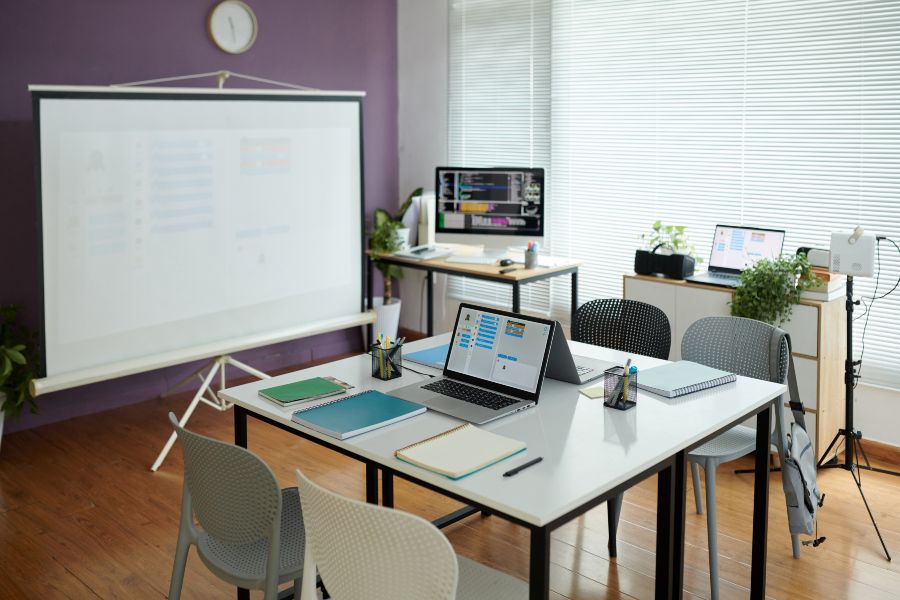
This is the costliest sign of all, and the most under-discussed. Turning away one client isn’t just lost revenue for that job; it’s lost referrals, lost repeat business, and a cap on how large your own business can grow. Every declined enquiry is compounded.
The good news: capacity constraints rooted in space, equipment, or logistics are solvable problems when you have the right facility behind you. Flexible workspace options, from a day pass to a dedicated desk to a private serviced office, let you grow incrementally without overcommitting. You scale the plan, not the risk.
Sign 9: Your Brand Image Doesn’t Match the Business You’ve Built
You’ve invested in a polished website, a professional online business presence, and a quality product or service. But your business card lists a residential suburb. Your “studio” is a corner of a spare bedroom. There’s a credibility gap, and savvy clients pick up on it, even when they don’t say anything directly.
Brand perception shapes pricing power, the calibre of clients you attract, and the partnerships available to you. For eCommerce and content-led businesses especially, access to a professional photography studio or podcast studio for content creation is part of the brand equation. The environment you work from communicates what kind of business you are. Make sure it says the right thing.
Sign 10: You Spend More Time Managing Home Logistics Than Growing
Negotiating with neighbours about delivery noise. Rearranging your living space for seasonal stock. Troubleshooting a home NBN connection mid-client call. Researching local requirements and council approval for home business zoning. These are real costs, not in dollars, but in founder time, which is the scarcest resource a growing business has.
Business.gov.au outlines a clear compliance picture for home business operations: business and tax registrations including an Australian Business Number, licences and permits depending on business type and location, council approval for businesses that generate traffic or employ staff, and landlord notification requirements for renters.
For example, if you sell goods online and need to set aside part of your property for storage or packaging, you may trigger council zoning requirements and landlord obligations simultaneously. Managing all of that from a residential address as the business grows is its own part-time job, and the time you pay to manage it is income that never gets made. A professional space removes most of that friction and returns your focus to the business activities that actually move the needle.
Your Next Office Space Doesn’t Need a Five-Year Lease.
Our dedicated desks start from $95/week and private offices and showrooms from $150/week, with month-to-month terms that flex as your business grows, whether you start with a dedicated desk or move straight into a private office space. See the full 9,000sqm Alexandria facility for yourself in the Bourke Rd eCommerce Hub tour on YouTube, then book a tour when you’re ready. Call us today – (02) 9381 9100
Your Business Has Outgrown Home: Here’s What Growing Businesses Do Next
From Kitchen Table to Professional Space: Making the Move Without the Risk
If you’ve been nodding along to this list, you’re not alone, and you’re not behind. You’ve built something real from your own home. That’s a genuine achievement. What the 10 signs above share is a common thread: when a home business reaches a growth inflection point, the home setup itself becomes the obstacle.
The good news is that the move doesn’t have to be all-or-nothing. A foundational Harvard Business Review study on coworking found that 84% of coworking members reported higher levels of engagement at work compared to those in traditional or home-based settings. Separately, independent research into coworking behaviour found that 79% of coworking members reported expanded professional networks after making the switch. These aren’t abstract benefits; they translate directly into client relationships, referrals, and business growth.
For Sydney-based businesses at this inflection point, Workit Spaces in Alexandria offers a full spectrum of workspace solutions: from virtual offices and dedicated desks to private office suites, eCommerce showrooms, meeting rooms, photography studios, and event spaces, all under one roof, with flexible terms that let you scale your business structure without overcommitting. Whether you need professional business premises for the first time or a complete facility to grow into, the infrastructure is already there.
You built this far from a kitchen table. The next chapter of your business plan doesn’t need to start from home. Book a tour and see what’s possible.